
A Hidden Risk Beneath the Surface | Why This Matters in Southern Arizona | What a Weed Barrier Actually Does (& Doesn’t Do) | Where Most Turf Installations Go Wrong | What Actually Prevents Weeds in Artificial Turf | What Most Homeowners Misunderstand | What Actually Matters (And Where to Focus) | Common Mistakes Homeowners Make | Is Artificial Turf Right for You? | The Bigger Picture: System vs. Product | A Long-Term Investment in Your Outdoor Space | Serving Homeowners Across Southern Arizona | Pro Insight: What This Really Means for You | FAQs: Weed Barriers & Artificial Turf
See Also: Why Weeds Grow in Turf (And How to Prevent It) | How to Maintain Artificial Turf to Prevent Weeds Long-Term | Professional Artificial Turf Installation Standards in Southern Arizona | Why Artificial Turf Fails (How Professionals Prevent It) | Artificial Turf Cost in Southern Arizona: A Strategic Investment Guide | The Science of Artificial Turf in the Arizona Climate | Don’t Choose Your Turf Company Based on Price Alone | Licensed vs Unlicensed Turf Installers in Arizona: What’s the Risk?
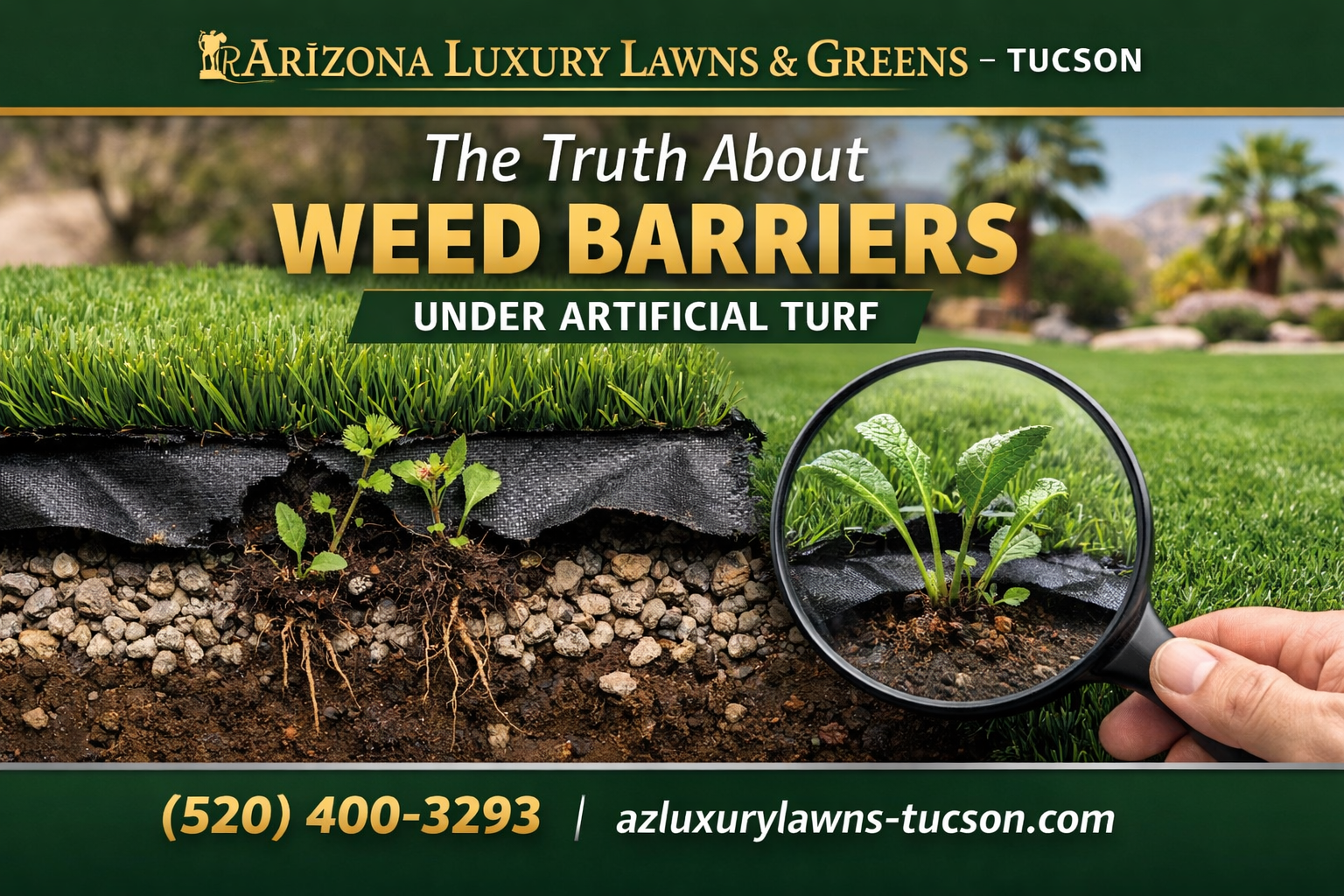

The Truth About Weed Barriers Under Artificial Turf
What Most Homeowners in Southern Arizona Get Wrong
A Hidden Risk Beneath the Surface
You’ve probably heard it before: “We install a weed barrier under your artificial turf, so you’ll never have to worry about weeds.” It sounds reassuring. Logical, even. But here’s what most homeowners don’t realize…Weed barriers alone don’t prevent weeds.
In fact, in Southern Arizona, relying on a weed barrier as your primary defense can create a false sense of security, one that often leads to frustration months or years after installation.
The truth is more nuanced and far more important if you want your investment to actually perform long-term.
Why This Matters in Southern Arizona
Artificial turf behaves very differently here than it does in milder climates. In Southern Arizona, your turf system is exposed to:
- Extreme heat (110°+ summers) that dries, shifts, and stresses materials
- Intense UV exposure that degrades lower-quality components
- Monsoon rains that introduce organic debris and moisture into the system
- Dust and airborne seeds that settle into the turf over time
- Expansive soils that shift beneath improperly prepared bases
This combination creates a key reality: After successful base preparation, weeds generally don’t just grow from below, they often grow from above.
What a Weed Barrier Actually Does (& Doesn’t Do)
What It Does Do
A properly installed weed barrier can:
- Reduce weed growth from existing soil below
- Help separate the base layer from native soil
- Provide an additional layer of protection during early stages
What It Does NOT Do
A weed barrier does not:
- Stop airborne seeds from settling into turf fibers
- Prevent organic debris buildup (which becomes a growing medium)
- Eliminate edge intrusion from surrounding areas
- Compensate for poor base preparation or drainage
In other words: A weed barrier is a supporting component, not a solution.
Where Most Turf Installations Go Wrong
This is where problems begin. Many installations treat the weed barrier as the primary line of defense instead of part of a broader system.
The Result?
- Weeds appear months later
- Homeowners feel misled
- Maintenance becomes reactive instead of preventative
And the common assumption is: “The weed barrier must have failed.” But in reality, the system was never designed correctly to begin with.
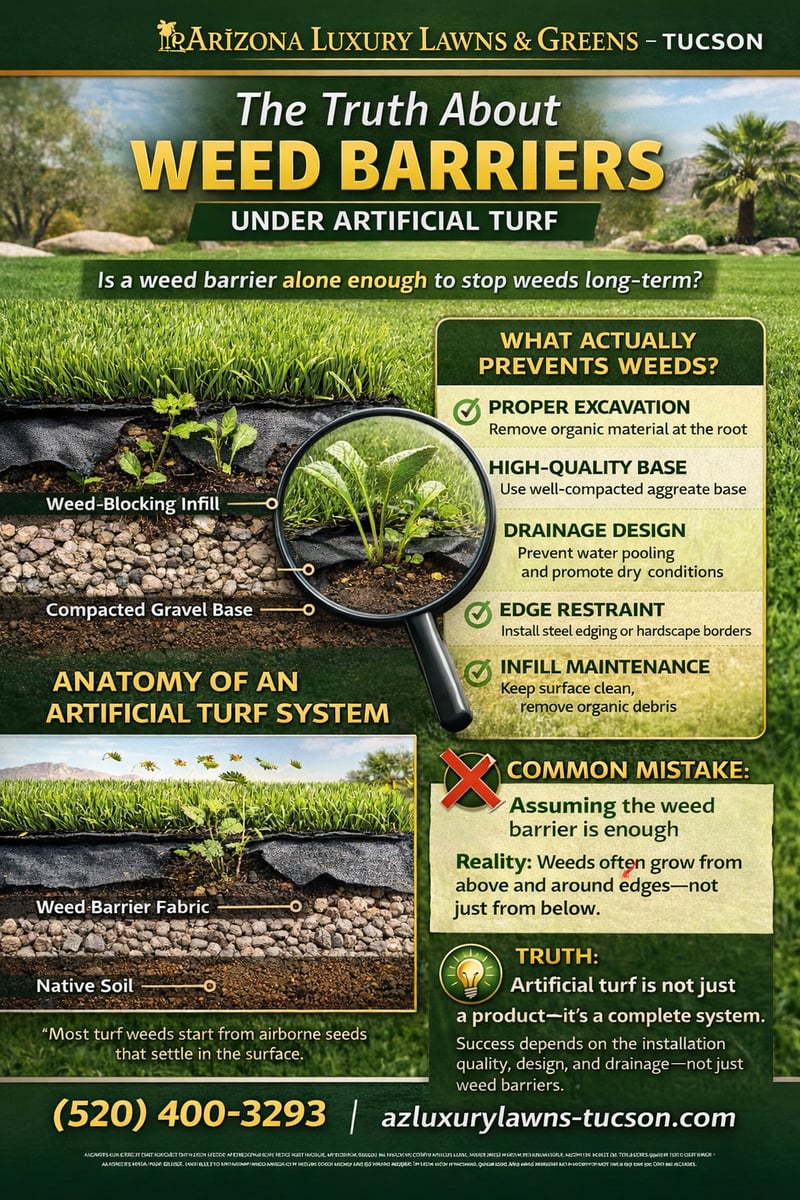
What Actually Prevents Weeds in Artificial Turf
If weed prevention is the goal, here are the factors that truly matters:
1. Proper Excavation
- Removal of organic material, roots, and debris
- Eliminating the conditions weeds need to regrow
2. High-Quality Base Preparation
- Typically, 1.5”–2” of compacted aggregate base
- Proper compaction prevents settling and intrusion
3. Drainage Design
- Prevents water pooling (which promotes growth)
- Supports long-term system stability
4. Edge Restraint Strategy
- Steel edging or hardscape borders
- Prevents weeds from creeping in from surrounding areas
5. Infill Selection & Maintenance
- Helps reduce organic buildup
- Supports turf structure and cleanliness
6. Ongoing Maintenance Awareness
- Removing debris before it becomes a growth medium
- Occasional inspections of edges and seams
Notice what’s missing? The weed barrier is not the primary factor.
What Most Homeowners Misunderstand
There’s a common belief: “If I choose the right turf product and add a weed barrier, I’m covered.”
But artificial turf performance has very little to do with the surface alone. It’s what’s happening beneath that determines whether your lawn stays clean or becomes a recurring maintenance issue.
What Actually Matters (And Where to Focus)
If you’re evaluating artificial turf in Southern Arizona, prioritize:
Installation Quality
- How deep is the excavation?
- How is the base compacted?
- What is the drainage strategy?
System Design
- How are edges secured?
- How are seams handled?
- How is water managed during monsoons?
Materials (Beyond the Turf)
- Infill type and volume
- Base material quality
- Border materials
Long-Term Performance
- How will this system perform in 3–5 years, not just day one?
Because again: Artificial turf is not a product, it is a system.
Common Mistakes Homeowners Make
- ⊗ “The weed barrier will handle it”
- Reality: It’s only one small layer in a much larger system
- ⊗ “If weeds show up, something failed”
- Reality: Most weeds originate from surface conditions, not below
- ⊗ “All installations are basically the same”
- Reality: Installation quality is the #1 driver of long-term results
- ⊗ “Cheaper bids are just better deals”
- Reality: Lower bids often cut corners in base prep and system design
Is Artificial Turf Right for You?
Artificial turf can be an excellent long-term solution, but only when expectations are aligned.
However, artificial turf performance has very little to do with the surface alone. It’s what’s happening beneath that determines whether your lawn stays clean or becomes a recurring maintenance issue.
It’s a great fit if you:
- Want a low-maintenance, water-saving landscape
- Value long-term performance over upfront cost
- Are willing to maintain basic cleanliness (like removing debris)
It may not be ideal if you:
- Expect zero maintenance forever
- Prioritize lowest price over installation quality
- Don’t address underlying landscape or drainage issues
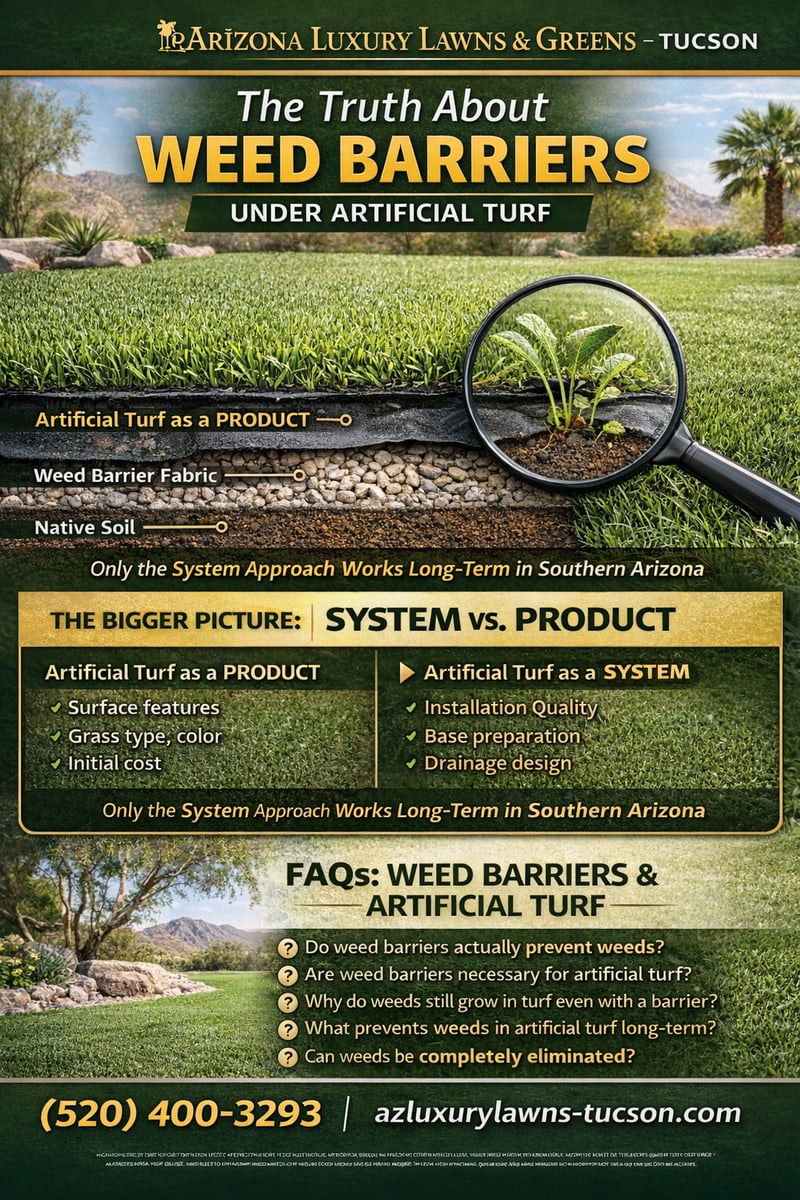
The Bigger Picture: System vs. Product
This is the most important takeaway. If you view artificial turf as:
- A product → You focus on grass type, color, and price
- A system → You focus on performance, longevity, and design
And in Southern Arizona, only one of those approaches consistently works.
A Long-Term Investment in Your Outdoor Space
When designed and installed correctly, artificial turf becomes:
- A clean, usable outdoor environment year-round
- A water-saving solution built for desert conditions
- A low-maintenance alternative to struggling natural grass
However, when corners are cut (especially by unlicensed or non-professionals), or expectations are misaligned, it becomes a cycle of fixes, frustration, and unnecessary expense.
Serving Homeowners Across Southern Arizona
At Arizona Luxury Lawns & Greens – Tucson, we take a system-first approach to every project. We work with homeowners, schools, and businesses throughout:
- Tucson
- Oro Valley
- Marana
- Sahuarita
- Green Valley
- Casa Grande
- ...and surrounding Southern Arizona communities
Because in this environment, success isn’t about selling turf, it is about designing a system that actually performs.
Pro Insight: What This Really Means for You
If a contractor emphasizes weed barriers as the primary solution, it’s worth asking deeper questions about:
- Their installation process
- Their base preparation standards
- Their long-term system design approach
Because in Southern Arizona, weed prevention isn’t about what’s underneath. It is about how the entire system is built.
FAQs: Weed Barriers & Artificial Turf
1. Do weed barriers actually prevent weeds under artificial turf?
Short answer: No, not by themselves.
Weed barriers can help reduce growth from existing soil below, but they do not stop:
- Airborne seeds settling into the turf
- Organic debris buildup (which becomes a growing medium)
- Weeds entering from edges or seams
In Southern Arizona, most weeds originate from surface conditions, not below, making system design far more important than the barrier itself.
2. Are weed barriers necessary for artificial turf installation?
They can be helpful, but they are not the deciding factor. A weed barrier is a supporting layer, not a solution. It may provide:
- Initial separation from native soil
- Minor protection during early stages
However, long-term weed prevention depends on:
- Proper excavation
- Compacted base installation
- Drainage design
- Edge restraint
A well-built system can perform effectively with or without a weed barrier, depending on conditions and design.
3. Why do weeds still grow in artificial turf even with a weed barrier?
Because weeds don’t need to grow from underneath. In Southern Arizona, weeds commonly grow due to:
- Dust and airborne seeds settling into turf fibers
- Organic debris (leaves, dirt) creating a growth layer
- Moisture from irrigation or monsoons
- Gaps along edges or seams
The weed barrier is below the system. The problem is often happening on top of it.
4. What is the best way to prevent weeds in artificial turf long-term?
Weed prevention is achieved through system design, not a single product. The most effective approach includes:
- Complete excavation (removing roots and organics)
- Proper base preparation (1.5”–2” compacted aggregate)
- Drainage strategy to prevent moisture buildup
- Edge restraint systems (steel or hardscape borders)
- Routine maintenance to remove debris early
When these elements are done correctly, weed issues are significantly reduced.
5. Can weeds be completely eliminated from artificial turf?
No, but they can be minimized to a very manageable level. Artificial turf is often described as “low maintenance”, not “no maintenance.” You may occasionally see:
- Small weeds from airborne seeds
- Growth near edges or high-debris areas
However, with a properly installed system:
- Weed growth is infrequent and easy to manage
- Maintenance is minimal compared to natural grass
The goal isn’t perfection; it is long-term control and performance.