
Artificial Turf Explained: Materials, Construction & Performance | Yarn Characteristics - What You See & Feel | Turf Construction Characteristics - The Performance Layer | Backing System - The Hidden Foundation | Performance Technologies & Features | Why These Components Matter | How to Evaluate Artificial Turf Like a Professional | Final Thoughts - Build It Right the First Time | FAQs About Artificial Turf Materials & Performance
See Also: Why Weeds Grow in Turf (And How to Prevent It) | How to Maintain Artificial Turf to Prevent Weeds Long-Term | Professional Artificial Turf Installation Standards in Southern Arizona | Why Artificial Turf Fails (How Professionals Prevent It) | Artificial Turf Cost in Southern Arizona: A Strategic Investment Guide | The Science of Artificial Turf in the Arizona Climate | Don’t Choose Your Turf Company Based on Price Alone | Licensed vs Unlicensed Turf Installers in Arizona: What’s the Risk?
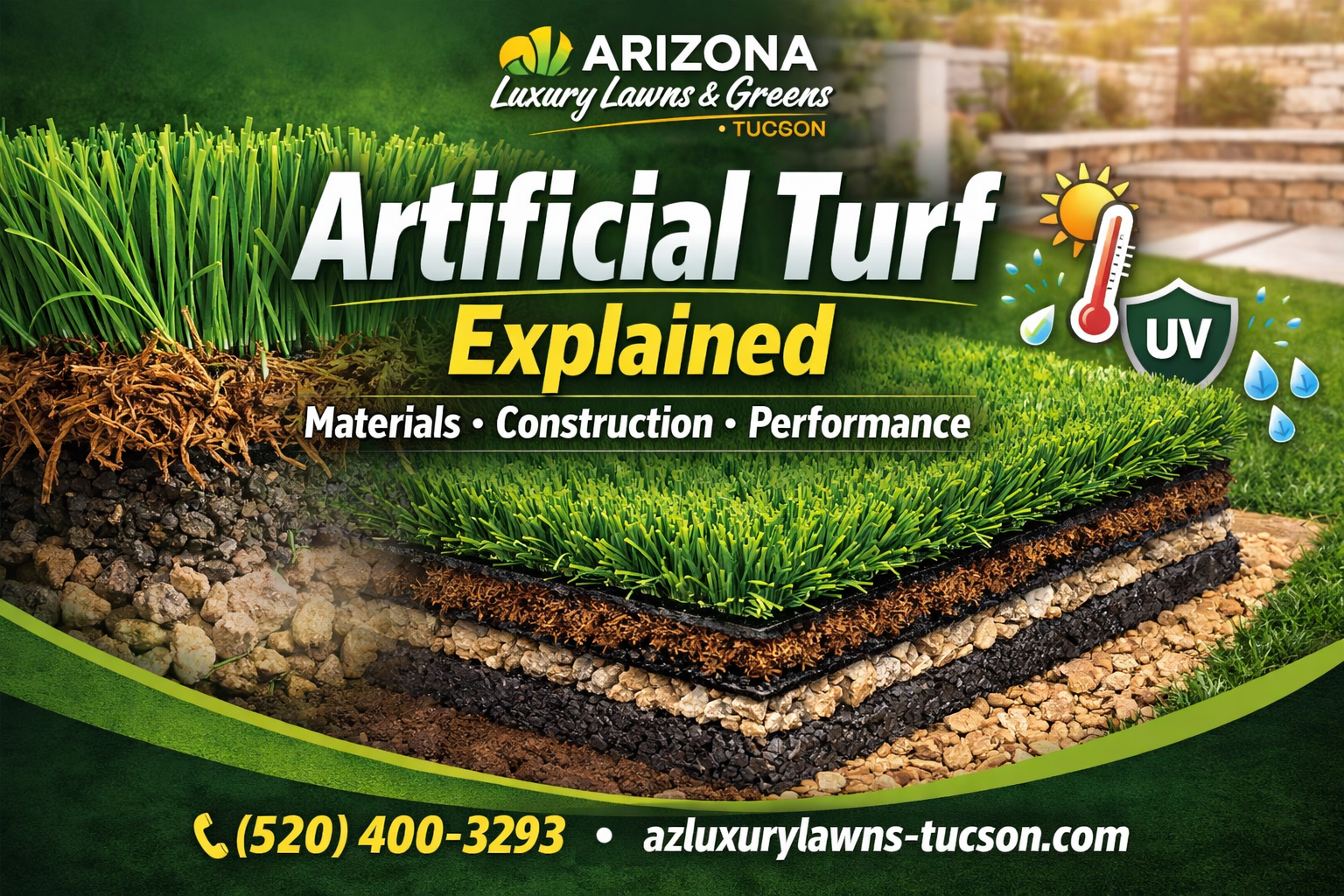

Artificial Turf Explained: Materials, Construction & Performance
Most homeowners believe artificial turf is simply a product you install and forget. But the reality is this: Artificial turf is a system - and every layer within that system determines how it performs over time. From the fibers you see to the backing you don’t, every component plays a role in:
- Durability
- Appearance
- Heat performance
- Maintenance requirements
- Long-term value
This guide is designed to help you understand what you’re really buying, so you can make a confident, informed decision.
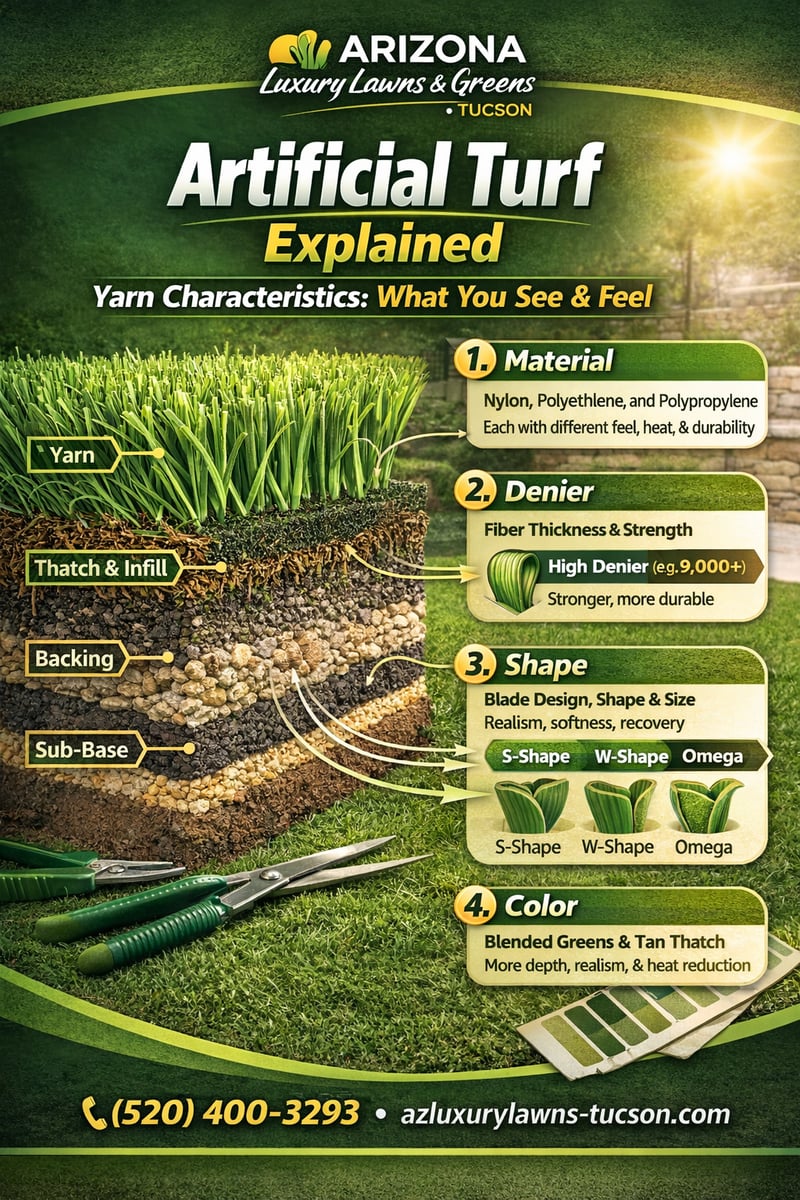
Yarn Characteristics - What You See & Feel
The yarn is the most visible part of your residential turf installation, backyard putting green installation, pet turf installation, or playground installations. It determines how your lawn looks on day one, and how it performs years later.
Yarn Type: Monofilament vs. Thatch Systems
- Monofilament Fibers
- Individual strands designed to mimic real grass blades
- Soft, natural feel
- Ideal for residential landscapes
- Thatch Layer (Secondary Fibers)
- Curled, shorter fibers beneath the surface
- Adds realism and structural support
- Helps blades recover after foot traffic
Why it matters: An artificial turf installation with both monofilament and thatch provides a balanced combination of aesthetics, durability, and resilience.
Material Composition: What the Fibers Are Made Of
- Polyethylene (PE)
- Nylon
- Extremely durable
- Holds shape well under heavy traffic
- Often used in putting greens or high-performance areas
- Polypropylene
- Lower-cost material
- Less durable and less heat-resistant
Why it matters: Material selection impacts comfort, longevity, and how well your turf holds up in Southern Arizona climate and extreme heat conditions.
Denier: Understanding Fiber Strength (Example: 9,000 / 5,000)
When evaluating artificial turf products, whether it be for a residential turf installation, backyard putting green installation, pet turf installation, or playground installation, one of the most misunderstood, but highly important specifications is denier. At its core: Denier measures the thickness and strength of individual turf fibers. But what does that actually mean for your lawn?
Denier is a unit of measurement that reflects the mass and thickness of a fiber strand.
- Higher denier (e.g. 9,000+)
- Thicker, stronger fibers
- Built for durability and structure
- Lower denier (e.g., 5,000–6,000)
- Finer, softer fibers
- Designed for comfort and realism
Many premium turfs combine:
- High denier fibers (e.g., 9,000) for strength
- Lower denier fibers (e.g., 5,000) for softness and realism
Why Premium Turf Uses Dual Denier Systems
Many high-quality artificial turf products combine multiple denier levels within a single system. For example:
- 9,000 denier fibers → provide durability and resilience
- 5,000 denier fibers → enhance softness and visual realism
This is often paired with a thatch layer, which further supports fiber recovery and adds depth. Why it matters: A dual-denier system allows turf to:
- Look natural
- Feel comfortable
- Withstand long-term use
- ...Withstand long-term use
How Denier Impacts Real-World Performance
Denier isn’t just a spec; it directly influences how your turf performs over time.
1. Wear Resistance
Higher denier fibers are more resistant to:
- Foot traffic/Play activity
- Pet activity
- Compression
This is especially important for:
- Backyards with pets
- High-use areas
- Putting green installations and play spaces
2. Fiber Recovery (Bounce-Back Ability)
Denier works together with:
- Thatch layer
- Infill system
- Turf density
To determine how well your turf recovers after being walked on.
- Low denier alone → can flatten more easily
- High denier + thatch → better long-term structure
This is a key concept in our guide: “Why Artificial Turf Fails (How Professionals Prevent It)”
3. Long-Term Appearance
Over time, lower-quality turf with poorly balanced denier may:
A properly engineered denier blend helps maintain:
- A natural look
- Consistent texture
- Visual depth
4. Overall Lifespan
Denier plays a direct role in how long your turf lasts.
- Higher denier = more resistance to breakdown
- Better fiber integrity = longer usable life
When combined with:
- Strong backing
- Proper installation
- Quality infill
You get a system capable of 10 to 15+ years of performance
Common Misconception: Higher Denier = Better Turf
Not always. This is where many homeowners get misled. Denier should never be evaluated in isolation. A turf product with extremely high denier but:
- Poor backing
- Low stitch rate
- Weak infill
…can still underperform. That’s why we emphasize throughout this guide: Artificial turf is a system, not a single specification.
The Bottom Line
Denier isn’t just a technical term; it is a performance indicator. The right denier combination helps your turf look better, last longer, and perform under real-world conditions. But remember: It’s not about choosing the highest number, it is about choosing the right system.
Color Blending: Realism vs. Artificial Look
High-quality turf uses multiple colors, such as:
- Field Green (AZ Designer 60 oz & 75 oz, AZ Ultra 60 oz & 75 oz, AZ Select 60 oz & 75 oz, AZ Multisport, AZ Petscape)
- Mid-Olive Green (AZ Designer 60 oz & 75 oz)
- Apple Green (AZ Ultra 60 oz & 75 oz)
- Olive Green (AZ Select 60 oz & 75 oz)
- Clover Green (AZ Multisport, AZ Petscape)
- Brown/Thatch tones (AZ Designer 60 oz & 75 oz, AZ Ultra 60 oz & 75 oz, AZ Select 60 oz & 75 oz, AZ Multisport, AZ Petscape)
Why it matters: Multi-tone systems replicate natural grass variation, creating a more realistic, high-end appearance.
Turf Construction Characteristics - The Performance Layer
This is where artificial turf product quality begins to separate.
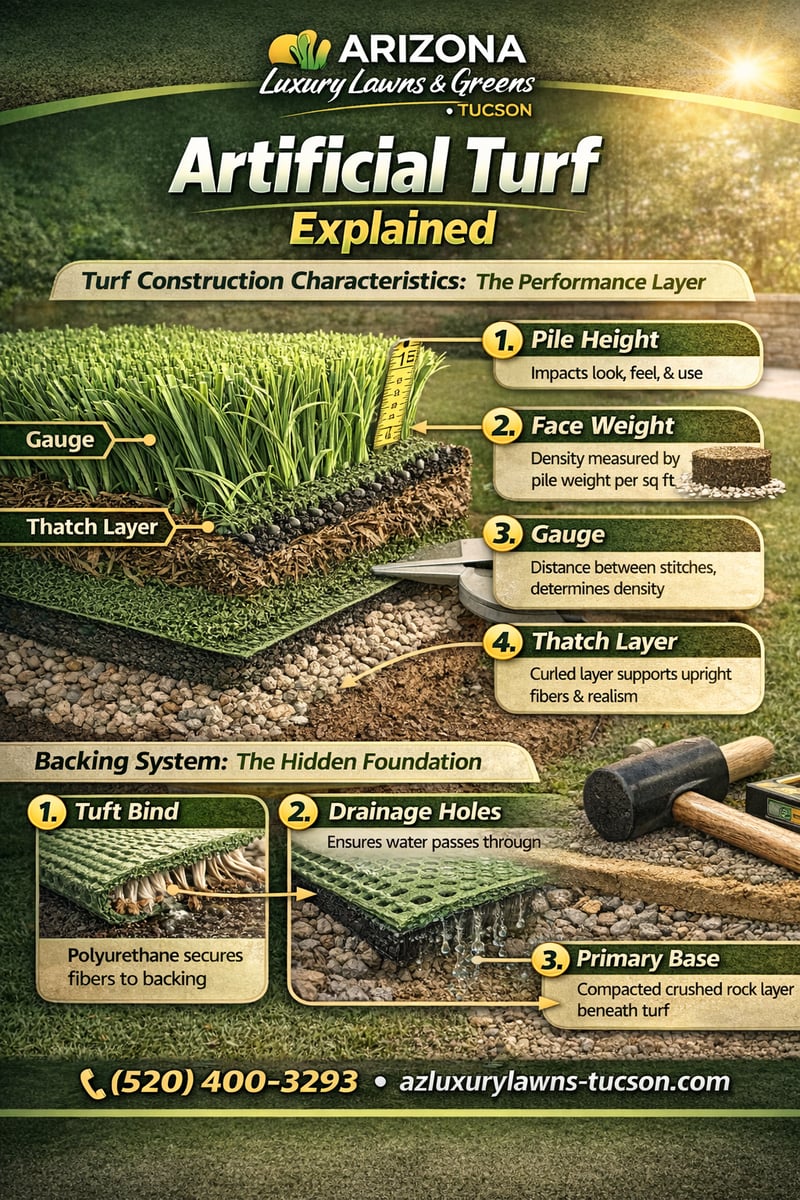
Pile (Face) Weight: Density vs. Marketing
Pile weight refers to the amount of yarn per square yard.
- Higher weight = more material
- But more isn’t always better
Professional Insight: Pile weight must be evaluated alongside:
- Stitch rate
- Yarn type
- Backing quality
Otherwise, it can be misleading.
Pile Height: Appearance vs. Performance
- Short (≤1.25”)
- Lower maintenance
- Less matting
- Ideal for high-traffic areas
- Medium (1.5”–1.75”)
- Balanced look and performance
- Tall (2.0”+)
- Plush appearance
- More prone to matting
Why it matters: Taller turf may look luxurious but often requires more maintenance to keep it upright.
Machine Gauge: Stitch Spacing & Density
Gauge refers to the distance between rows of stitches.
- Tighter gauge = more stitches = higher density
- Wider gauge = less dense, lower cost
Why it matters: Density impacts:
- Durability
- Blade support
- Overall performance
Thatch Layer: The Unsung Hero
When most homeowners look at artificial turf, their focus is on the visible grass blades, but what truly supports the entire system is what sits just beneath them: the thatch layer. The thatch is made up of shorter, curled fibers woven into the turf, designed to mimic the natural undergrowth you’d find in real grass. But it does far more than just improve appearance.
It plays a critical role in helping the turf blades stay upright, especially after foot traffic, pets, or everyday use, which is why you will find thatch in our AZ Designer 60 oz & 75 oz, AZ Ultra 60 oz & 75 oz, AZ Select 60 oz & 75 oz, AZ Multisport, AZ Petscape products. Without it, even high-quality fibers can start to lean, flatten, or lose their structure over time.
Just as importantly, the thatch layer adds depth and variation in color, those subtle browns and lighter tones that make artificial turf look more like a natural lawn instead of a flat, uniform surface. Over time, this becomes one of the biggest differentiators between turf that continues to look great and turf that starts to look worn out.
Without a proper thatch layer, artificial turf installations can quickly appear flat, shiny, and artificial. This is why, when evaluating turf, it’s important to look beyond just pile height or face weight and consider how the thatch, yarn structure, and overall system work together.
Because in a well-designed artificial turf system, the thatch isn’t just a detail - it’s what keeps everything performing the way it should.
Backing System - The Hidden Foundation
If the yarn is what you see…The backing is what determines whether your investment lasts.
Primary Backing
This is the material that holds the fibers in place.
- Must be strong, stable, and resistant to stretching
- Poor backing leads to seam separation and failure
Secondary Coating (Finish Layer)
Typically:
- Polyurethane (Premium)
- Latex (Lower cost)
Polyurethane advantages:
- Stronger bond
- Better moisture resistance
- Longer lifespan
Backing Weight: Structural Integrity
Heavier backing typically means:
- More material
- Better durability
- Stronger fiber retention
Tuft Bind (10+ Pounds Explained)
Tuft bind measures how much force is required to pull fibers from the backing.
- 10+ pounds = high-quality turf
Why it matters: Low tuft bind = fibers loosen over time = premature failure.
Seam Strength: Where Projects Often Fail
Seams are the most vulnerable part of any installation. High-quality backing systems:
- Improve seam adhesion
- Prevent separation
- Extend system lifespan
Performance Technologies & Features
Modern turf systems are engineered, not just manufactured.
Heat Reduction Technology (TigerCool™)
- Designed to reflect sunlight
- Reduces surface temperature by up to 15%
Why it matters: Lower surface temperatures = more usable outdoor space
UV Stabilization
- Protects fibers from sun degradation
- Prevents fading and brittleness
Drainage & Permeability
- Allows water to pass through efficiently
- Critical for monsoon conditions
Environmental & Safety Features
Premium turf systems are:
Why it matters: Safe for pets, kids, and long-term environmental impact.
Why These Components Matter
Here’s the truth most homeowners don’t hear: Artificial turf doesn’t fail because of one issue - it fails because of system weaknesses. Each component influences:
Longevity
A properly built system can last 10 to 15+ years.
Appearance Over Time
Cheap systems:
- Mat down
- Fade
- Lose structure
Maintenance Requirements
Better systems require:
- Less brushing
- Less repair
- Fewer interventions
Total Cost of Ownership
Lower upfront cost often leads to:
- Higher long-term expenses
- Early replacement
How to Evaluate Artificial Turf Like a Professional
Before choosing a contractor or product, ask:
About the Turf
- What is the yarn composition?
- What is the denier rating?
- What is the tuft bind strength?
About the System
- What backing is used (polyurethane vs latex)?
- What is the drainage design?
- What infill is recommended?
About Installation
- How deep is excavation?
- What base materials are used?
- How are seams handled?
Red Flag: If the conversation is only about price per square foot, you’re not getting the full picture.
Final Thoughts - Build It Right the First Time
Artificial turf is an investment in your property, your lifestyle, and your outdoor space. But like any system: Its performance is only as strong as the weakest component.
Understanding the materials, construction, and technology behind your turf empowers you to:
- Avoid costly mistakes
- Choose the right system
- Maximize long-term value
FAQs About Artificial Turf Materials & Performance
1. What is the most important factor when choosing artificial turf?
The most important factor isn’t a single specification. It is how the entire turf system works together. Artificial turf performance depends on:
- Yarn quality (material, denier, structure)
- Turf construction (pile height, density, thatch layer)
- Backing strength (tuft bind, coating, seam integrity)
- Installation quality (factors like base preparation, drainage, compaction)
Professional insight: Focusing on just one metric, like price or face weight, can be misleading. Long-term performance comes from a balanced, well-designed system.
2. Does artificial turf get hot in Arizona?
Artificial turf can get warm in direct sunlight, especially in climates like Southern Arizona. However, modern artificial turf products are designed to reduce heat through:
- Heat-reflective technologies (like TigerCool™)
- Lighter color blends
- Proper infill selection
Professional insight: Temperature management isn’t just about the turf. It is about the entire system design, including airflow, infill, and surrounding materials including hardscapes.
3. How long does artificial turf last?2. Does artificial turf get hot in Arizona?
A professionally designed and installed artificial turf system can last 10 to 15+ years, or greater. Longevity depends on:
- Material quality
- Fiber strength (denier)
- Backing integrity (tuft bind, coating)
- Installation standards
- Level of use (pets, traffic, activities)
Key takeaway: Higher-quality systems may cost more upfront, but they typically last longer and require less maintenance, making them a better long-term investment.
4. What is face weight (pile weight) in artificial turf, and does it matter?
Face weight (or pile weight) refers to the amount of yarn used per square yard of turf. While higher face weight often indicates a denser product, it should not be used as a standalone measure of quality. It must be evaluated alongside:
- Yarn type and denier
- Stitch rate (machine gauge)
- Thatch layer
- Backing strength
Key takeaway: Some lower-quality products increase face weight artificially without improving performance. What matters most is how all components work together as a system.
5. What type of backing is best for artificial turf?
The best artificial turf systems use a high-quality backing with a strong secondary coating, typically polyurethane. Key factors to look for:
- Strong primary backing material
- Durable secondary coating (polyurethane preferred over latex)
- High tuft bind (10+ pounds)
- Reinforced seam strength
Why it matters: takeaway: The backing holds everything together. If it fails, the entire turf system can fail, regardless of how good the fibers look.